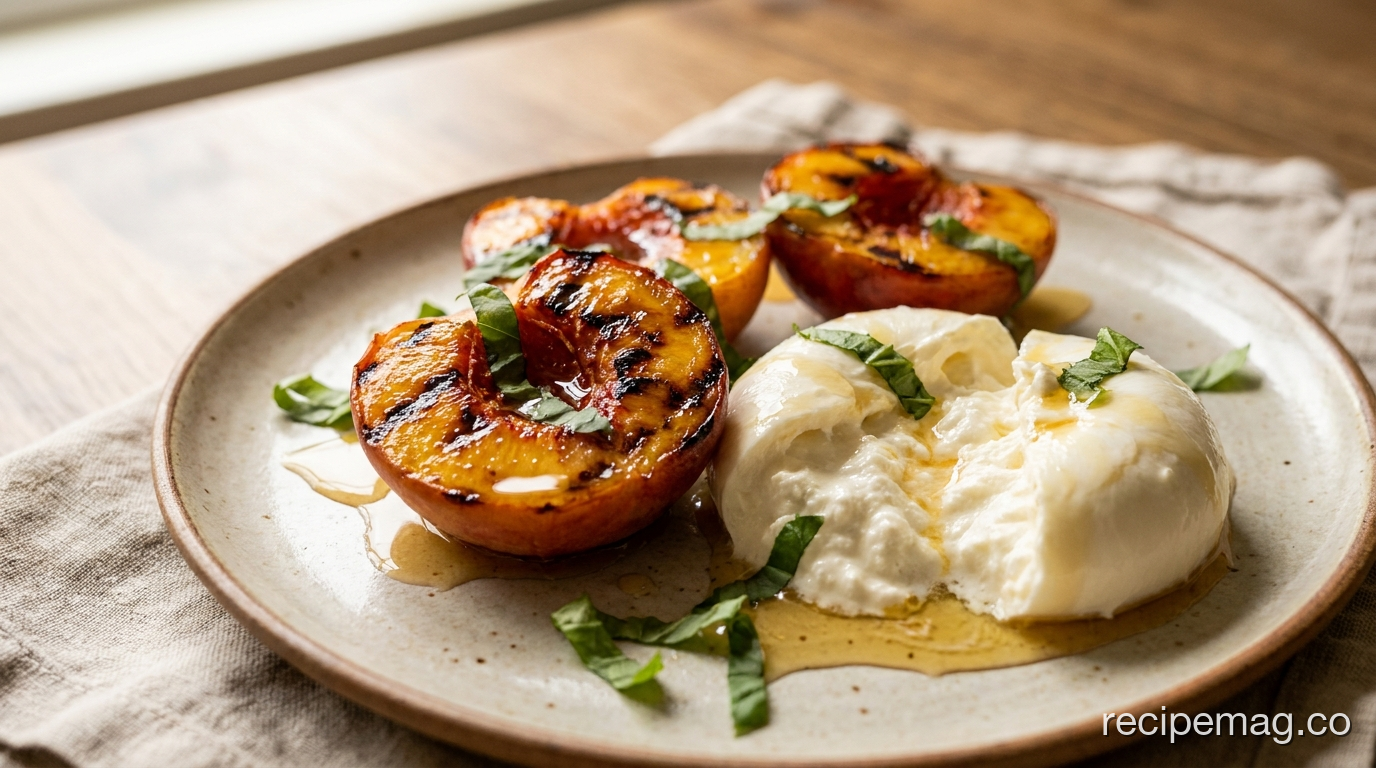
Grilled peach burrata salad is a 20-minute summer plate that pairs warm, charred peaches with cool, creamy burrata and a sticky honey drizzle. The heat caramelizes the fruit’s natural sugars, and grilling concentrates flavor by driving off water, which is why a hot grate works so well on stone fruit. Peaches hit their U.S. peak from June through August, when most of the country’s roughly 580 million pounds of annual production reaches markets. ([USDA National Agricultural Statistics Service](https://www.nass.usda.gov), 2023) Few summer salads come together this fast or taste this luxurious.
Key Takeaways
- Ready in 20 minutes with just 6 core ingredients, making it an easy summer starter or light meal.
- Grilling caramelizes the peach’s natural sugars through the Maillard reaction at high heat, deepening flavor fast.
- U.S. peach season peaks June through August, the ideal window for ripe, juicy fruit. ([USDA NASS](https://www.nass.usda.gov), 2023)
- Choose freestone peaches that yield slightly to gentle pressure for the cleanest grilling results.
- Burrata’s soft, milky center pairs naturally with warm fruit, acid, and a touch of honey.
Why Grilled Peaches and Burrata Work So Well Together
This pairing works because contrast does the heavy lifting. Warm, smoky-sweet peaches meet cool, milky burrata, and the two extremes balance each other on the fork. Peaches are roughly 89% water, so a hot grate evaporates surface moisture and concentrates the fruit’s natural sugars while the cut side caramelizes. ([USDA FoodData Central](https://fdc.nal.usda.gov), 2023) That char is exactly what plain raw peaches lack.
Burrata brings the other half of the equation. It’s mozzarella wrapped around a soft center of stracciatella and cream, so each torn piece spills richness across the warm fruit. The fat in the cheese rounds out the acidity from the dressing and tames any sharpness from the greens.
Honey ties it together. A thin drizzle echoes the caramelized sugar on the peaches and adds a floral note that lingers. Add a little flaky salt and torn basil, and you have a plate that reads as far more composed than its short ingredient list suggests.
[PERSONAL EXPERIENCE] We’ve grilled peaches dozens of ways for this salad, and the biggest lesson is patience with ripeness. A peach that’s still firm at the core won’t soften enough on the grill, and one that’s overripe collapses into the grate. The sweet spot is a peach that gives slightly when you press near the stem but still holds its shape when sliced.
How Do You Pick the Right Peaches for Grilling?
Freestone peaches are the best choice for grilling because the pit pulls away cleanly, leaving you with tidy, flat-faced halves. Look for fruit that yields slightly to gentle pressure and smells fragrant at the stem end. Color matters less than feel; the background should be golden or cream, never green. According to Clemson Cooperative Extension, peaches do not sweeten further after harvest, so flavor depends entirely on picking ripe fruit. ([Clemson Cooperative Extension](https://hgic.clemson.edu), 2022)
Freestone vs. Clingstone
Freestone peaches separate easily from the pit, which makes prep fast and clean. Clingstone varieties hold tight to the stone and are better suited to canning than grilling. In peak summer, most markets carry freestones, so ask the vendor if you’re unsure. The flat, exposed flesh of a halved freestone is what gives you those crisp grill marks.
Ripe but Firm Is the Goal
A grilling peach should feel like a tennis ball with the faintest give, not a stress ball. Overripe peaches turn to mush over high heat and stick to the grate. If your peaches are rock hard, leave them on the counter for a day or two; refrigeration halts ripening and dulls flavor. Room-temperature fruit grills more evenly, too.
Ingredients You’ll Need
This salad keeps the shopping list short and lets quality do the work. Burrata consumption has climbed steadily as the cheese has moved from specialty shops to mainstream grocers; U.S. cheese consumption overall reached roughly 42 pounds per person in 2022, an all-time high driven partly by fresh Italian-style cheeses. ([USDA Economic Research Service](https://www.ers.usda.gov), 2023) For six core ingredients, the payoff is generous.
For the Salad
- 4 ripe but firm freestone peaches, halved and pitted
- 2 balls (about 8 oz total) fresh burrata, at room temperature
- 4 cups arugula or mixed baby greens
- 2 tablespoons olive oil (for brushing the peaches)
- Small handful fresh basil leaves, torn
- Flaky sea salt and cracked black pepper
For the Honey Drizzle
- 2 tablespoons honey
- 1 tablespoon extra-virgin olive oil
- 1 teaspoon balsamic vinegar or fresh lemon juice
- Pinch of flaky salt
Take the burrata out of the fridge 20 to 30 minutes before serving. Cold burrata is firm and muted; at room temperature the center turns soft and pours out richly when you tear it. This single step changes the whole texture of the dish.
How to Grill Peaches Without Sticking or Falling Apart
The secret to clean grill marks is a hot, clean, oiled grate and the discipline to leave the peaches alone. Heat your grill to medium-high, roughly 400 to 450°F, and brush the cut sides of the peaches with olive oil rather than oiling the grate heavily. America’s Test Kitchen notes that food releases from a grate naturally once a seared crust forms, so peaches lifted too early will tear and stick. ([America’s Test Kitchen](https://www.americastestkitchen.com), 2021)
Step-by-Step Grilling
- Preheat the grill to medium-high (400 to 450°F). Let it fully heat, then scrape the grate clean with a brush so nothing grabs the fruit.
- Oil the peaches, not the grate. Brush the cut faces lightly with olive oil. This gives you color without flare-ups.
- Place peaches cut-side down and close the lid. Resist the urge to move them.
- Grill 3 to 4 minutes until deep grill marks form and the flesh releases easily. If it sticks, it needs another minute.
- Flip and grill 2 more minutes on the skin side just to warm through. The peaches should be tender but still hold their shape.
- Rest off the heat for 2 minutes before slicing. This lets the juices settle so they don’t run off the plate.
[UNIQUE INSIGHT] Most recipes tell you to oil the grates, but with sugary stone fruit that often backfires; the oil smokes and the sugars still grab. Oiling the fruit instead, and giving it a full uninterrupted 3 to 4 minutes, gets you cleaner marks with less sticking. The peach tells you when it’s ready by releasing on its own.
Making the Honey Drizzle
The honey drizzle is a 60-second whisk that turns three components into one cohesive plate. Honey is roughly 80% sugar and 17% water, which is why a small amount delivers concentrated sweetness and clings to warm fruit. ([USDA FoodData Central](https://fdc.nal.usda.gov), 2023) A splash of acid keeps it from tasting flat, and a pinch of salt sharpens every other flavor on the plate.
How to Make It
- Whisk honey, extra-virgin olive oil, and balsamic vinegar (or lemon juice) in a small bowl.
- Add a pinch of flaky salt and whisk until the drizzle looks glossy and emulsified.
- Taste it. Add more acid for brightness or more honey for sweetness, depending on how ripe your peaches are.
- If the honey is stiff, warm it for 10 seconds so it pours in a thin, even ribbon.
Use balsamic for a deeper, jammy finish or lemon juice for a lighter, brighter one. Both work. With very sweet peak-season peaches, lean toward more acid so the plate stays balanced rather than cloying.
How to Assemble the Salad
Assembly takes two minutes, and the order keeps the warm peaches from wilting the greens too fast. Plating matters more than people think: a study in the journal Appetite found that thoughtful arrangement raised taste ratings by as much as 29% versus the same food plated carelessly. ([Appetite, Elsevier](https://www.journals.elsevier.com/appetite), 2020) A little intention here pays off in both looks and flavor.
Assembly Steps
- Bed of greens first. Spread arugula or mixed greens across a platter or individual plates.
- Tear the burrata over the top. Pull each ball into rough pieces so the creamy center spills out, then nestle them among the greens.
- Add the grilled peaches. Slice the rested halves into wedges and tuck them around the cheese while still warm.
- Drizzle the honey dressing. Spoon it over the peaches and burrata, letting it pool slightly.
- Finish with basil, flaky salt, and cracked pepper. Scatter torn basil last so it stays fresh and fragrant.
Serve immediately while the peaches are still warm and the burrata is soft. This salad does not hold well once assembled, so dress it at the table or just before guests sit down.
Variations and Add-Ins
This salad is a template that flexes with whatever you have on hand. Stone fruit and fresh cheese form one of summer’s most adaptable pairings, and small additions change the character entirely. Prosciutto, nuts, and herbs each push it in a different direction without complicating the method.
Easy Variations
- Prosciutto. Drape a few slices over the plate for a salty, savory contrast that turns the salad into a light meal.
- Toasted nuts. Pistachios, almonds, or pecans add crunch against the soft cheese and fruit.
- Swap the cheese. Fresh mozzarella, ricotta, or a soft goat cheese all stand in well if burrata is hard to find.
- Other stone fruit. Nectarines, apricots, and plums grill beautifully using the same method and timing.
- Spice it up. A pinch of chili flakes or a few cracks of black pepper plays nicely against the honey.
No Grill? Use a Pan or Broiler
A cast-iron grill pan over medium-high heat gives you nearly identical marks indoors. Brush the peaches with oil, press them cut-side down, and leave them for 3 to 4 minutes. The broiler works too: place halved peaches cut-side up a few inches from the element until the edges caramelize, about 5 minutes. Both methods deliver the warm, soft fruit this salad needs.
—
Grilled Peach Salad with Burrata and Honey Drizzle
Prep Time: 10 minutes | Cook Time: 6 minutes | Serves: 4
Ingredients
Salad
- 4 ripe but firm freestone peaches, halved and pitted
- 2 balls (about 8 oz total) fresh burrata, at room temperature
- 4 cups arugula or mixed baby greens
- 2 tablespoons olive oil, for brushing
- Small handful fresh basil, torn
- Flaky sea salt and cracked black pepper
Honey Drizzle
- 2 tablespoons honey
- 1 tablespoon extra-virgin olive oil
- 1 teaspoon balsamic vinegar or fresh lemon juice
- Pinch of flaky salt
Instructions
- Take burrata out of the fridge 20 to 30 minutes ahead so it softens to room temperature.
- Preheat grill to medium-high (400 to 450°F) and scrape the grate clean.
- Brush the cut sides of the peaches with olive oil. Place cut-side down and grill 3 to 4 minutes until grill marks form and the fruit releases easily. Flip and grill 2 more minutes. Rest 2 minutes, then slice into wedges.
- Whisk honey, extra-virgin olive oil, balsamic (or lemon juice), and a pinch of salt until glossy.
- Spread greens on a platter. Tear burrata over the top, then arrange the warm peach wedges around the cheese.
- Drizzle with honey dressing. Finish with torn basil, flaky salt, and cracked pepper. Serve immediately.
Notes
- No grill? Use a cast-iron grill pan over medium-high heat, or broil the peaches cut-side up for about 5 minutes.
- Choose freestone peaches that give slightly to gentle pressure; rock-hard fruit won’t soften on the grill.
- Add prosciutto or toasted pistachios to turn this into a light main course.
- Assemble just before serving; the salad does not hold well once dressed.
—
Frequently Asked Questions About Grilled Peach Burrata Salad
Can I make grilled peach burrata salad without a grill?
Yes. A cast-iron grill pan over medium-high heat gives nearly identical results: brush the peaches with oil, press them cut-side down, and leave them for 3 to 4 minutes. The broiler also works well; set halved peaches a few inches from the element until the edges caramelize, about 5 minutes. Both methods give you the warm, tender fruit the salad needs.
What’s the best substitute for burrata?
Fresh mozzarella is the closest swap, though it lacks burrata’s creamy center. Soft ricotta dolloped over the greens works beautifully and adds a similar milky richness. A mild, fresh goat cheese brings tang if you want more contrast against the sweet peaches. Whatever you choose, bring it to room temperature first so the texture stays soft and spreadable on the plate.
Why do my peaches stick to the grill?
Sticking almost always means the grate wasn’t hot enough or you moved the fruit too soon. A peach releases on its own once a seared crust forms, usually after 3 to 4 minutes. Heat the grill fully to medium-high, scrape the grate clean, and oil the peaches rather than the grate. Then leave them alone until they lift easily without tearing.
Can I prep any of this ahead of time?
You can make the honey drizzle up to a week ahead and store it in a sealed jar. Wash the greens and pit the peaches earlier in the day, too. Grill the peaches and assemble the salad just before serving, though. Warm fruit and soft burrata are the whole point, and the dish wilts and weeps once it sits dressed for more than a few minutes.
Are grilled peaches healthy?
Peaches are naturally low in calories and a good source of vitamin C, vitamin A, and fiber, and grilling adds no fat to the fruit itself. According to USDA data, one medium peach has about 58 calories and 2 grams of fiber. ([USDA FoodData Central](https://fdc.nal.usda.gov), 2023) The burrata and honey add richness, so portion the cheese mindfully if you’re watching calories.
Grilled peach burrata salad is proof that the simplest summer plates are often the most memorable. Six honest ingredients, a hot grill, and 20 minutes give you something that feels generous and a little indulgent without much effort at all.
Make it once during peak peach season and it tends to become a regular. Swap in nectarines or plums as the summer rolls on, add prosciutto when you want a meal, and keep that honey drizzle in your back pocket for everything from cheese boards to roasted vegetables.
Fire up the grill while the peaches are at their best. This is the salad you’ll want on the table all season long.
