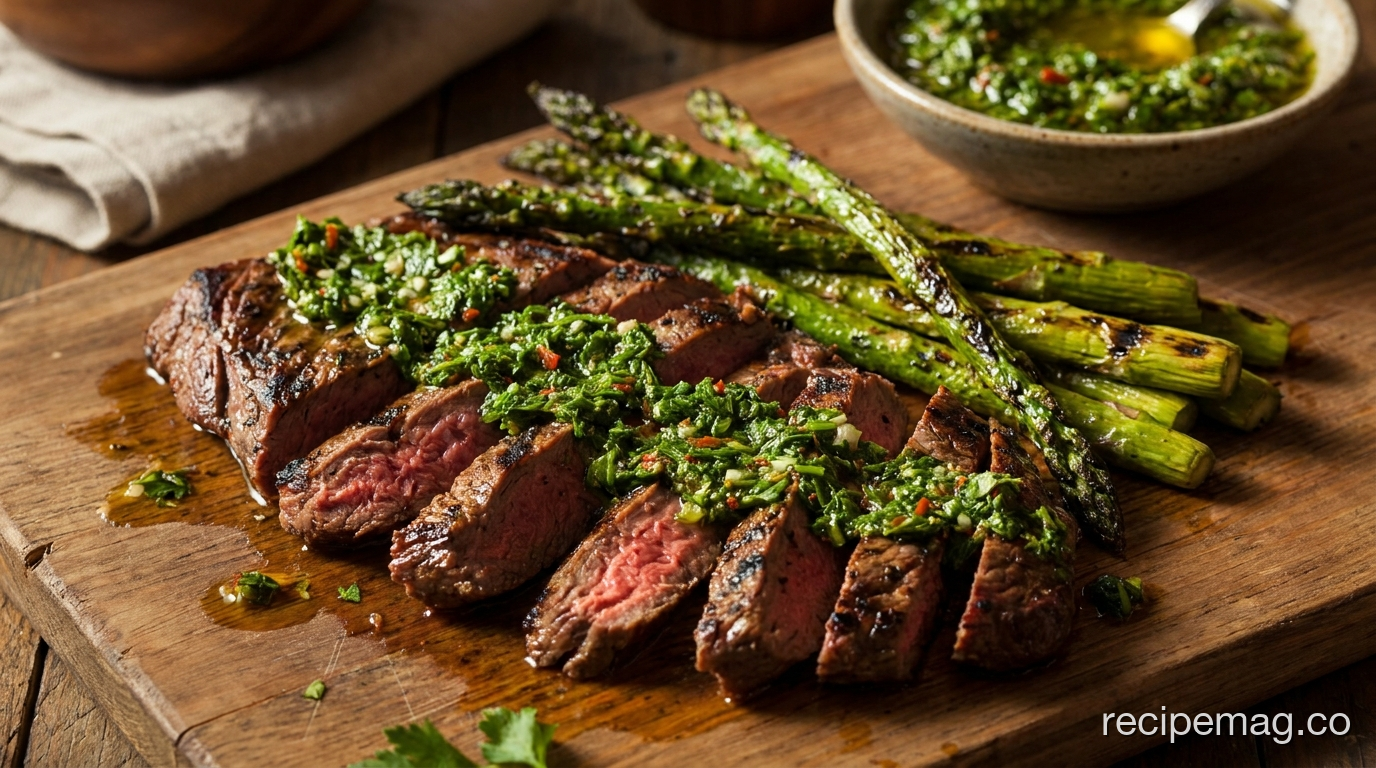
Chimichurri skirt steak is a fast, high-reward summer dinner: you sear a thin cut over screaming-hot coals for two minutes a side, rest it, then slice it thin against the grain and spoon a bright, hand-chopped parsley sauce over the top. Skirt steak is built for this treatment. It’s thin, deeply beefy, and forgiving when you cook it hot and fast. Grilled asparagus shares the fire and finishes in the same few minutes. Dinner for four, start to finish, lands in well under an hour.
Key Takeaways
- Skirt steak is thin, so a hot grill (around 500°F surface) sears it in roughly 2 to 3 minutes per side.
- Rest the steak 5 to 10 minutes so the juices redistribute instead of running onto the board.
- Slicing thin against the grain shortens muscle fibers and measurably improves tenderness. ([America’s Test Kitchen](https://www.americastestkitchen.com), 2022)
- Real chimichurri is chopped by hand, not blended, which keeps the herbs bright green and the texture loose.
- The whole plate, steak plus asparagus, comes together in about 45 minutes and serves four.
Why Is Skirt Steak Perfect for High-Heat Grilling?
Skirt steak is thin, loose-grained, and packed with flavor, which makes it ideal for a fast, ferociously hot sear. The cut comes from the plate, near the cow’s diaphragm, and it’s prized for that deep, mineral beefiness. Because it’s only about half an inch thick, it cooks through in minutes, so high heat builds a dark, savory crust before the inside overcooks. The USDA notes that thin cuts reach a safe medium-rare quickly when seared hot. ([USDA FoodData Central](https://fdc.nal.usda.gov), 2023)
The trade-off is a short window. Skirt steak goes from perfect to gray in about a minute, so this isn’t a cut you walk away from. Get everything ready first: chimichurri made, asparagus trimmed, tongs in hand. Then cook.
[PERSONAL EXPERIENCE] We’ve grilled this cut dozens of times, and the single biggest improvement always comes from heat, not seasoning. A grill that’s merely warm steams the steak gray and leaves it tough. A grill hot enough to make you flinch when you hold a hand over it gives you the crust this cut deserves.
How Do You Make Real Chimichurri by Hand?
Chimichurri is a raw, uncooked sauce of finely chopped parsley, oregano, garlic, vinegar, and olive oil, and the best version is made by hand with a knife. Blending turns it into a dull, dark paste. Chopping keeps the herbs bright green and the texture loose and spoonable. Serious Eats and other culinary authorities recommend hand-chopping precisely because a blender bruises the parsley and muddies both color and flavor. ([Serious Eats](https://www.seriouseats.com), 2021) Ten minutes with a sharp knife is all it takes.
Chimichurri Ingredients
- 1 cup fresh flat-leaf parsley, finely chopped (packed before chopping)
- 2 tablespoons fresh oregano, finely chopped (or 2 teaspoons dried)
- 4 garlic cloves, minced
- ½ teaspoon red pepper flakes
- 2 tablespoons red wine vinegar
- ½ cup extra-virgin olive oil
- ½ teaspoon salt, plus more to taste
How to Make It
- Chop the parsley and oregano finely by hand. Avoid the food processor. You want distinct flecks of green, not a purée.
- Mince the garlic as fine as you can, or grate it on a microplane for a softer bite.
- Combine the parsley, oregano, garlic, red pepper flakes, vinegar, and salt in a bowl. Stir.
- Pour in the olive oil and stir again. Let the sauce sit at least 10 minutes before serving so the flavors marry.
Make the chimichurri first, before you light the grill. It only improves as it rests, and a 20-minute head start lets the garlic mellow and the vinegar soften. Leftovers keep in the fridge for up to a week and turn almost anything, eggs, roasted potatoes, grilled chicken, into something better.
How Do You Prep and Season Skirt Steak?
Good prep is mostly about dryness and salt. Pat the steak bone-dry with paper towels, because a wet surface steams instead of searing and never browns. Then salt it well. Salt does more than season the surface: applied ahead of time, it draws out moisture that then reabsorbs, seasoning the meat throughout. America’s Test Kitchen found that salting at least 40 minutes before cooking produces noticeably more tender, evenly seasoned beef than salting right before the grill. ([America’s Test Kitchen](https://www.americastestkitchen.com), 2022)
Trimming and Salting
- Trim the membrane. Skirt steak sometimes has a thin silverskin on one side. Slip a knife under it and peel it off so it doesn’t seize on the grill.
- Cut into manageable lengths. A full skirt steak is long. Cut it into two or three pieces that fit your grill comfortably.
- Dry it well. Press both sides firmly with paper towels. A dry surface is the price of a good crust.
- Salt early. Season both sides generously with kosher salt and black pepper, ideally 40 minutes ahead. A light coat of oil helps the crust form.
Skip the long marinade. Skirt steak has so much natural flavor that an acidic marinade can actually start to break down the surface into mush before you even cook it. Salt, pepper, oil, and a hot fire are all this cut needs. The chimichurri brings the brightness afterward.
What’s the Right Way to Grill Skirt Steak?
Cook it hot, fast, and only briefly. Skirt steak wants the hottest fire you can build, roughly 500°F at the grate, and just 2 to 3 minutes per side for medium-rare. Use an instant-read thermometer and pull it at 130 to 135°F, knowing carryover heat will push it up during the rest. The USDA lists 145°F as the safe minimum for whole beef cuts, with a rest afterward. ([USDA Food Safety and Inspection Service](https://www.fsis.usda.gov), 2023)
Step-by-Step Grilling
- Build a hot fire. For charcoal, bank a full chimney of lit coals into a single hot zone. For gas, run the burners on high with the lid down for 10 to 15 minutes. You want to hold your hand over the grate for no more than 2 seconds.
- Clean and oil the grate. Scrub it, then wipe it with an oiled paper towel held in tongs. A clean, oiled grate prevents sticking and tearing.
- Sear the first side. Lay the steak down and leave it alone for 2 to 3 minutes. Don’t move it. You’re building the crust.
- Flip once. Turn the steak and sear the second side for another 2 to 3 minutes.
- Check the temperature. Pull the steak at 130 to 135°F for medium-rare. Thinner sections cook faster, so check the thickest part.
- Move to a board. Transfer to a cutting board to rest. Don’t slice yet. That’s the next critical step.
[UNIQUE INSIGHT] The most common mistake we see is flipping skirt steak too often, chasing the perfect sear. Resist it. Each time you lift the steak, you interrupt the crust forming on the grate. One flip, two confident sears, done. The cut is too thin to benefit from fussing, and every extra flip costs you browning.
Why Should You Rest and Slice Against the Grain?
Resting and slicing direction decide whether your steak is tender or chewy, and both cost you nothing but patience and attention. Rest the steak 5 to 10 minutes so the juices, driven to the center by the heat, can redistribute. Then look at the muscle fibers and slice thin, perpendicular to them. America’s Test Kitchen demonstrated that slicing against the grain shortens the muscle fibers your teeth have to work through, making even a chewy cut taste markedly more tender. ([America’s Test Kitchen](https://www.americastestkitchen.com), 2022)
Finding the Grain
- Look for the lines. Skirt steak has a long, obvious grain running the length of the cut. Those parallel lines are the muscle fibers.
- Cut across them. Position your knife at a 90-degree angle to the fibers and slice. Cutting with the grain leaves long, tough strands.
- Slice thin. Aim for quarter-inch slices. Thin slices against the grain are the single biggest factor in how tender this steak eats.
- Angle the knife. A slight bias cut, holding the blade at 45 degrees, gives wider, more attractive slices on a thin cut.
Why does resting matter so much on a thin cut? Because skirt steak is mostly surface. Slice it the second it leaves the grill and a puddle of juice runs onto the board, leaving the meat dry. Five minutes is enough for a cut this thin. Tent it loosely with foil if your kitchen is cold, but don’t wrap it tight or the crust will steam and soften.
How Do You Grill the Asparagus Alongside?
Asparagus is the ideal grill partner because it cooks in the same brief, hot window as the steak. Toss trimmed spears with oil and salt, lay them across the grate, and roll them for 4 to 6 minutes until charred and crisp-tender. High, dry heat suits asparagus: a 2021 review of cooking methods found that grilling and roughly preserve more of asparagus’s heat-stable nutrients than boiling, which leaches them into the water. ([Journal of Food Science, Wiley](https://ift.onlinelibrary.wiley.com/journal/17503841), 2021)
Grilling Steps for Asparagus
- Trim the woody ends. Snap one spear; it breaks where the tender part begins. Line the rest up and cut them to match.
- Toss with oil and salt. Use just enough olive oil to coat. Season with salt and pepper.
- Lay across the grate. Place spears perpendicular to the bars so they don’t fall through. A grill basket works too.
- Grill 4 to 6 minutes. Roll them every minute or two. They’re done when they’re charred in spots and bend slightly but still have a little snap.
- Finish with chimichurri or lemon. A spoonful of the same chimichurri ties the plate together. A squeeze of lemon works too.
Thick spears grill better than pencil-thin ones, which tend to overcook and go limp before they char. If you only have thin asparagus, cut the grill time to 3 or 4 minutes and watch them closely. They share the fire with the steak, so timing is easy: start the asparagus when you flip the steak and everything finishes together.
Tips for the Best Chimichurri Skirt Steak
A handful of small choices separate a good plate from a great one. Most of them come down to heat, timing, and restraint. Skirt steak rewards confidence: a hot fire, a single flip, an honest rest, and clean slices against the grain.
- Make the sauce first. Chimichurri needs at least 10 minutes to come together, and it holds for a week. Build it before you touch the grill.
- Get the grill truly hot. If you can hold a hand over the grate for more than 2 seconds, it’s not hot enough for skirt steak.
- Use a thermometer. Pull at 130 to 135°F for medium-rare. Guessing on a thin cut is how steaks end up overcooked.
- Rest, then slice. Five to ten minutes off the heat, then thin slices against the grain. Skip either step and the steak turns chewy.
- Don’t over-marinate. Skirt steak has plenty of flavor. Salt, pepper, and a hot fire are enough; the chimichurri does the rest.
- Save the juices. Pour any board juices back over the sliced steak before serving. That’s pure flavor.
—
Chimichurri Skirt Steak with Grilled Asparagus
Prep Time: 20 minutes | Cook Time: 10 minutes | Rest Time: 10 minutes | Serves: 4
Ingredients
Chimichurri
- 1 cup fresh flat-leaf parsley, finely chopped
- 2 tablespoons fresh oregano, finely chopped (or 2 teaspoons dried)
- 4 garlic cloves, minced
- ½ teaspoon red pepper flakes
- 2 tablespoons red wine vinegar
- ½ cup extra-virgin olive oil
- ½ teaspoon salt, plus more to taste
Steak and Asparagus
- 1½ to 2 pounds skirt steak, trimmed and cut into grill-length pieces
- 1 pound asparagus, woody ends trimmed
- 2 tablespoons olive oil, divided
- Kosher salt and black pepper
- Lemon wedges, for serving
Instructions
- Make the chimichurri: finely chop the parsley and oregano by hand. Combine with garlic, red pepper flakes, vinegar, and salt. Stir in the olive oil. Let rest at least 10 minutes.
- Prep the steak: pat dry with paper towels. Season both sides generously with kosher salt and pepper, ideally 40 minutes ahead. Rub with a little oil.
- Build a hot fire: charcoal banked into one hot zone, or gas on high with the lid down 10 to 15 minutes. Clean and oil the grate.
- Grill the steak: sear 2 to 3 minutes per side, flipping once. Pull at 130 to 135°F for medium-rare. Move to a cutting board.
- Grill the asparagus: toss with oil, salt, and pepper. Grill 4 to 6 minutes, rolling, until charred and crisp-tender.
- Rest the steak 5 to 10 minutes. Slice thin against the grain on a slight bias.
- Serve: arrange sliced steak and asparagus on a platter. Spoon chimichurri over the steak and asparagus. Pour any board juices over the top. Serve with lemon wedges.
Notes
- For food safety, the USDA recommends a minimum internal temperature of 145°F for whole beef cuts; many cooks prefer 130 to 135°F for medium-rare and rest longer.
- Chimichurri keeps refrigerated for up to 1 week. Bring to room temperature before serving.
- No grill? Use a cast-iron skillet over high heat or a hot broiler. The thin cut sears well on a screaming-hot pan.
- Flank steak is the closest substitute; it’s slightly thicker, so add a minute per side.
—
Frequently Asked Questions About Chimichurri Skirt Steak
Why do you slice skirt steak against the grain?
Skirt steak has long, tough muscle fibers running the length of the cut. Slicing against the grain, perpendicular to those fibers, cuts them into short pieces so your teeth do far less work. America’s Test Kitchen has shown this single move makes a chewy cut eat noticeably more tender. ([America’s Test Kitchen](https://www.americastestkitchen.com), 2022) Slice thin, on a slight bias, for the best texture.
Should chimichurri be blended or chopped?
Chopped, by hand, with a knife. Blending bruises the parsley and releases chlorophyll unevenly, turning the sauce dark and muddy in both color and flavor. Hand-chopping keeps the herbs bright green and the texture loose and spoonable, which is how traditional Argentine chimichurri is made. It takes about 10 minutes and the result is unmistakably fresher than a blended version.
What temperature should I cook skirt steak to?
For medium-rare, pull the steak at 130 to 135°F and let carryover heat finish it during the rest. The USDA lists 145°F as the safe minimum internal temperature for whole beef cuts, with a three-minute rest. ([USDA FSIS](https://www.fsis.usda.gov), 2023) Use an instant-read thermometer in the thickest part, since skirt steak’s uneven thickness cooks at different rates.
Can I make this without a grill?
Yes. A cast-iron skillet over high heat or a hot broiler both sear skirt steak well. Get the pan smoking hot, add a thin film of oil, and cook 2 to 3 minutes per side. The goal is the same as the grill: a dark, fast crust without overcooking the thin interior. Rest and slice against the grain exactly the same way.
How long does chimichurri last?
Stored in a sealed jar in the refrigerator, chimichurri keeps for up to a week. The color darkens slightly over time as the herbs sit in vinegar and oil, but the flavor stays bright. Bring it to room temperature before serving so the olive oil loosens. Beyond steak, it’s excellent on grilled chicken, roasted vegetables, eggs, and crusty bread.
Chimichurri skirt steak is proof that a great summer dinner doesn’t need a long cook or a long ingredient list. A hot fire, a thin cut, and a fresh herb sauce do the work. The whole plate comes together faster than most weeknight pasta.
Get the order right and the rest is easy. Make the chimichurri first. Build a hot fire. Sear the steak two minutes a side, rest it, and slice it thin against the grain. The asparagus rides along on the same coals.
Spoon that bright green sauce over everything and pour the board juices back on top. Fire up the grill this week and see how little it takes to cook a steak this good.
