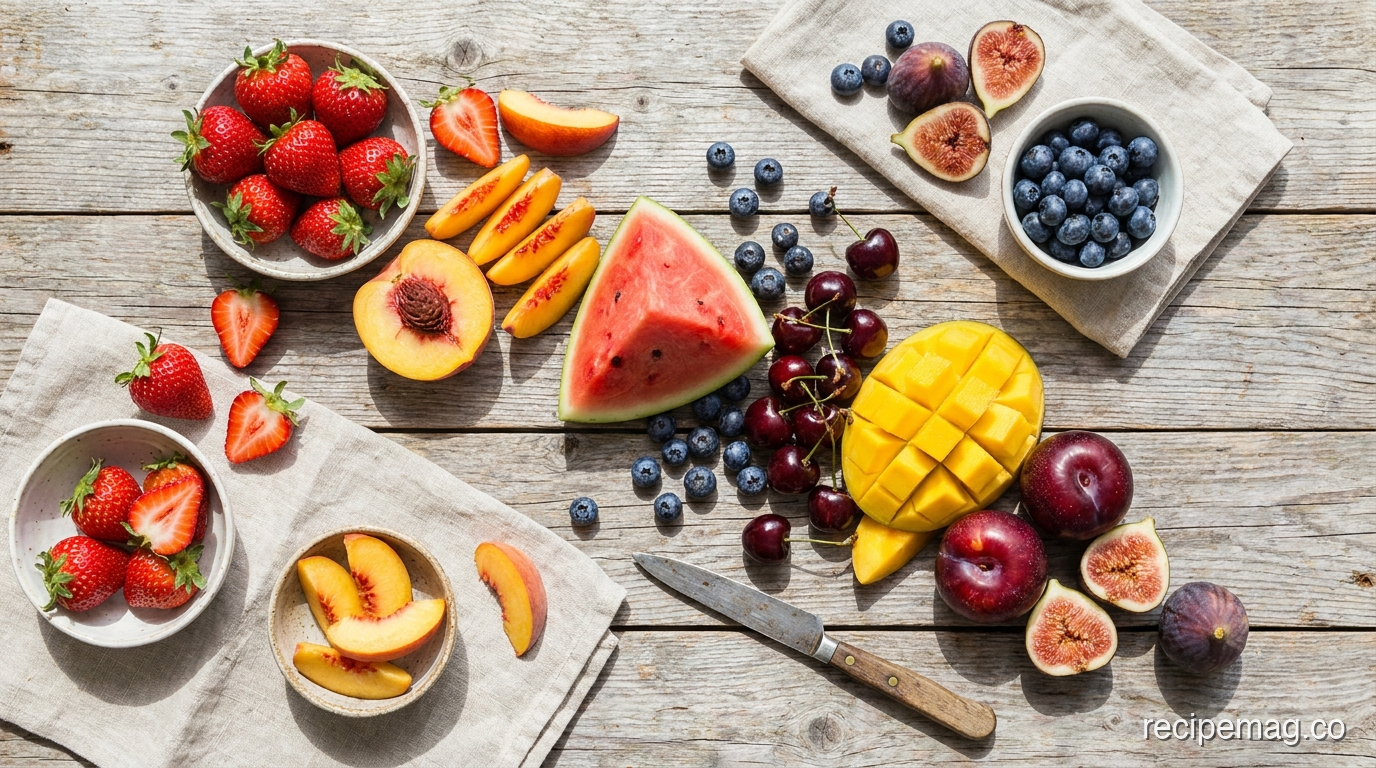
Most supermarket fruit travels an average of 1,500 miles before it reaches your table, according to the Leopold Center for Sustainable Agriculture. That distance costs flavor. Buying seasonal fruit at its local peak can mean the difference between a mealy, tasteless peach and one so ripe it drips down your chin. This guide tells you exactly which summer fruits to buy, when to buy them, and what to do with them.
Key Takeaways
- Seasonal fruit harvested locally contains significantly more nutrients and flavor than fruit shipped long distances.
- The prime summer fruit window runs June through August, with each fruit hitting its own peak week.
- Proper storage extends shelf life by 3-5 days for most stone fruits and berries.
- The 8 best summer fruits: strawberries, peaches, watermelon, blueberries, cherries, mangoes, plums, and figs.
- Per the USDA, Americans who eat seasonal produce consume 20% more daily fruit servings on average.
Why Does Seasonal Fruit Taste Better?
Fruit grown for local seasonal sale contains measurably more nutrients and sugar than fruit bred for the supply chain. The University of California, Davis found that locally grown seasonal strawberries contained up to 40% more vitamin C than shipping varieties (UC Davis Postharvest Technology Center, 2022). The reason is simple: fruit allowed to ripen fully on the plant converts more starch to sugar.
Commercial fruit varieties are selected for durability, not taste. A tomato that ships well is not the same tomato your grandmother grew. The same logic applies to peaches, plums, and figs. When you buy in season, you’re buying a different product entirely.
There’s also the nutrition angle. A 2021 review in Frontiers in Nutrition found that fresh seasonal produce retained 20-40% more antioxidants than produce stored for three weeks or more (Frontiers in Nutrition, 2021). Buying at the peak means you eat fruit at its nutritional maximum, not after a slow decline in a refrigerated truck.
Peak Season Calendar: June Through August
Each summer fruit has a narrow peak window, often just 4-8 weeks wide. The USDA Agricultural Marketing Service confirms that U.S. cherry season spans only 6-8 weeks from late May to early July, and missing it means paying premium prices for imported alternatives (USDA AMS, 2023). Knowing the calendar is the single most useful thing you can do for your summer cooking.
| Fruit | June | July | August | Peak Month |
|---|---|---|---|---|
| Strawberries | Peak | Tail | – | June |
| Cherries | Peak | Early | – | June |
| Blueberries | Early | Peak | Tail | July |
| Peaches | Early | Peak | Peak | July-Aug |
| Watermelon | – | Early | Peak | August |
| Mangoes | Peak | Tail | – | June |
| Plums | Early | Peak | Peak | July-Aug |
| Figs | – | Early | Peak | August |
The 8 Best Summer Fruits: How to Pick, Store, and Use Them
Knowing which fruit to buy is only half the equation. Picking a ripe one from a bin of fifty requires knowing what to look for. These eight fruits represent the best of the summer season in both flavor and versatility.
Strawberries
Peak month: June (early to mid)
A ripe strawberry should be fully red from tip to stem, with no white shoulders. Smell is your best tool here. If it doesn’t smell like a strawberry from six inches away, it won’t taste like one either. Local June strawberries are far smaller and more intensely flavored than the large hothouse varieties sold year-round.
How to store: Do not wash until ready to eat. Keep unwashed in a single layer on a paper towel in the fridge for up to 3 days. Hulled and halved strawberries freeze well for smoothies.
Best uses: Fresh shortcake, macerated with sugar and basil, stirred into yogurt, or blended into a quick jam. [LINK: recipe – classic strawberry shortcake]
Peaches
Peak month: July through mid-August
Buy peaches that yield slightly to gentle thumb pressure near the stem. Avoid any with green patches, which signals they were picked too early. A ripe peach has a deep floral scent and warm golden-orange skin, often with a rosy blush. Freestone varieties (where the pit separates cleanly) are easiest to work with in the kitchen.
How to store: Ripen at room temperature on the counter. Once ripe, move to the fridge and use within 2 days. Never refrigerate an underripe peach; cold halts the ripening process permanently.
Best uses: Grilled with honey and thyme, sliced into salads, baked in cobblers, or blended into a vinaigrette. [LINK: recipe – grilled peach and burrata salad]
Watermelon
Peak month: August
The yellow spot on the bottom of a watermelon is your friend. Called the “field spot,” it shows where the melon rested on the ground as it ripened. A creamy yellow spot means it was left on the vine long enough. A white or pale yellow spot means it was picked early. Also tap it: a hollow thump means ripe; a dull thud means underripe.
How to store: Whole watermelon keeps at room temperature for up to 2 weeks. Cut watermelon should be wrapped tightly and refrigerated for up to 5 days.
Best uses: Sliced cold, cubed in a mint and feta salad, blended into agua fresca, or grilled for a smoky-sweet side dish.
Blueberries
Peak month: July
Look for blueberries with a silvery-gray bloom on the skin. That dusty coating is natural and actually signals freshness, not age. Avoid any that are red or green; those are unripe and very tart. Give the container a gentle shake: berries should roll freely. Any that are stuck together are starting to break down.
How to store: Keep unwashed in the original container in the fridge for up to 10 days. Rinse only before eating. They freeze exceptionally well; spread in a single layer to freeze, then transfer to a bag.
Best uses: Folded into muffins or pancakes, tossed with lemon zest and honey, spooned over Greek yogurt, or simmered into a quick sauce for pork.
Cherries
Peak month: June
Fresh cherries should be shiny, plump, and deeply colored, either dark red-black for Bings or bright red for Rainiers. The stem should be green and slightly flexible, not brown or brittle. Softness or wrinkling means they’re past their prime. Buy them from a farmers market if you can: commercial cherries often sit in cold storage for weeks before reaching shelves.
How to store: Refrigerate immediately and keep dry. Cherries last 5-7 days in the fridge. Do not wash until ready to eat.
Best uses: Eaten fresh, pitted and baked into a clafoutis, simmered into a sauce for duck or lamb, or muddled in cocktails.
Mangoes
Peak month: June (for U.S.-grown Florida varieties)
Color is a poor guide for mangoes because varieties differ so widely. Squeeze gently instead. A ripe mango gives slightly, like a ripe avocado. It should also smell sweet and floral near the stem end. Ataulfo (honey) mangoes are smaller, yellow, and often considered the most complex in flavor. Tommy Atkins, the most common supermarket variety, is fibrously texted and mild.
How to store: Ripen on the counter. Once ripe, refrigerate and use within 3 days. Diced mango freezes well for smoothies and salsas.
Best uses: Diced in salsa with lime and jalapeño, blended into lassi or smoothies, added to grain salads, or eaten simply with Tajin and lime.
Plums
Peak month: July through August
A ripe plum gives to gentle pressure and has a slight powdery bloom on the skin, similar to blueberries. The flesh near the pit should be deeply fragrant. Black plums are richer and more jammy; red varieties are firmer and slightly tart. Italian prune plums, available in late August, are drier, denser, and ideal for baking.
How to store: Ripen at room temperature. Ripe plums keep in the fridge for 3-5 days. They freeze well when halved and pitted.
Best uses: Sliced over porridge, roasted with thyme and balsamic, baked into a galette, or simmered into a sauce for grilled chicken or pork. [LINK: recipe – roasted plum galette]
Figs
Peak month: August (second crop; the first, smaller crop arrives in June)
Figs are one of the most perishable fruits you’ll ever buy. They’re ripe when they’re heavy, slightly soft, and beginning to split near the base. A small drop of honey-like liquid at the opening is a sign of peak sweetness. Brown Turkey and Black Mission are the most common varieties. Kadota figs are milder, green-yellow, and pair well with savory dishes.
How to store: Figs last only 2-3 days after purchase, even in the fridge. Keep them in a single layer on a plate, uncovered. Do not wash until serving.
Best uses: Halved on a charcuterie board, roasted with honey and walnuts, sliced over flatbread with blue cheese, or warmed and spooned over vanilla ice cream.
How Should You Store Summer Fruit So It Lasts?
Storage mistakes destroy more summer fruit than pests ever could. The FDA Food Safety guidelines confirm that cut fruit held above 40°F for more than two hours enters the bacterial growth danger zone (FDA, 2023). The general rule: ripen at room temperature, then refrigerate once ripe. The one exception is cut watermelon, which should be refrigerated immediately.
Stone fruits, including peaches, plums, and cherries, suffer in cold storage before they ripen. Refrigerating an unripe peach doesn’t pause ripening cleanly. It actually changes the cell structure, producing a mealy, dry texture that no amount of patience will fix. Buy stone fruit one to two days ahead and leave it on the counter.
[PERSONAL EXPERIENCE] In practice, the single most useful storage habit is the paper towel trick. Lining a container with dry paper towels before adding berries or figs absorbs excess moisture, which is the primary cause of premature mold. We’ve seen this extend blueberry shelf life by 3-4 days compared to storing them in the original container with no lining.
What Are the Best Ways to Use Summer Fruit in Cooking?
Summer fruit works best in recipes that respect its natural sweetness. The National Restaurant Association’s Chef Survey ranked dishes featuring seasonal local fruit among the top 10 menu trends for three straight years (2021-2023), with flavor intensity cited as the key driver (NRA, 2023). The takeaway for home cooks: let the fruit do the work.
[UNIQUE INSIGHT] Most fruit dessert recipes call for more sugar than necessary when made with peak-season fruit. In our experience, reducing the sugar by 25-30% in any jam, crumble, or compote recipe produces a more complex, less candy-like result when you start with genuinely ripe summer fruit. The natural acidity and sugar are already balanced; adding a full cup of granulated sugar simply flattens that complexity.
Heat transforms summer fruit in interesting ways. Grilling peaches or watermelon over high heat caramelizes surface sugars and adds smokiness, turning them into a versatile savory-sweet element. Roasting figs or plums concentrates their juice into a sauce-like consistency without any thickener. These techniques require no special skill, just good timing and ripe fruit.
Fruit also works beyond dessert. Mango and cherry both pair naturally with proteins: mango salsa alongside grilled fish, cherry reduction spooned over roasted duck. Blueberries fold into vinaigrettes and grain salads without overwhelming other flavors. The versatility of peak-season summer fruit extends well past the dessert course.
Frequently Asked Questions About the Summer Fruits Season Guide
When is the best time to buy peaches?
Peaches peak between mid-July and mid-August in most U.S. growing regions. Look for fruit that gives slightly to thumb pressure and smells floral near the stem. The USDA NASS crop calendar confirms Georgia, South Carolina, and California lead U.S. production during this window. Avoid peaches with any green skin; they won’t ripen properly off the tree.
Is frozen fruit as nutritious as fresh seasonal fruit?
Often, yes. A 2017 study in the Journal of Food Composition and Analysis found that frozen produce matched or exceeded fresh store-bought produce in 8 of 17 measured nutrients, largely because freezing happens close to harvest (JFCA, 2017). Frozen fruit is a reliable off-season option. But nothing replaces truly ripe in-season fruit for flavor and full nutrient density.
How do you know if a watermelon is ripe?
Check the field spot (the yellow patch on the bottom). A deep creamy yellow means the watermelon ripened fully on the vine. A white or light spot means it was picked early. Tap the melon: a hollow, resonant thump signals ripeness. A dull thud means it’s underripe. Weight matters too. Pick up two similar-sized melons and choose the heavier one.
Can you mix summer fruits for storage?
Generally, no. Many fruits emit ethylene gas as they ripen, which accelerates ripening (and spoilage) in neighboring produce. According to the University of Maine Cooperative Extension, high ethylene producers like peaches and plums should be stored away from berries, which are highly sensitive to the gas (UMaine Extension, 2022). Store each fruit type separately for maximum shelf life.
What is the best summer fruit for baking?
Peaches, plums, and blueberries are the most reliable baking fruits. They hold texture under heat, release enough liquid to create a sauce without making crusts soggy, and their flavor intensifies rather than dulls when cooked. Figs bake beautifully but are more perishable, so bake them within a day of purchase. Strawberries and cherries work well in baked goods but release more liquid, so recipes often call for thickeners like cornstarch.
Start Buying Seasonal This Week
The summer fruit window is short. Cherries disappear before you’ve eaten your fill. Figs are ripe for days, not weeks. The calendar above tells you exactly where you are in the season and what to prioritize at the farmers market this weekend.
The practical takeaways are straightforward. Buy stone fruit one to two days before you need it and ripen it on the counter. Store berries unwashed with a paper towel. Use your nose at the market: if it smells like the fruit it is, buy it. If it doesn’t, don’t.
Summer fruit doesn’t need much help in the kitchen. A ripe peach sliced over yogurt, a bowl of cherries eaten cold, a fig split open with a drizzle of honey. These aren’t recipes; they’re arguments for buying better fruit at the right time. The season is here. Use it.
